PDPM: How does it really work?
The Patient Driven Payment Model (PDPM) was introduced in October 2019 to reduce the administrative burden on nurses and create a fair reimbursement logic. In this article, we explain how the PDPM works, what's new and why an accurate PDPM documentation is so important.

What is the PDPM?
The Patient Driven Payment Model (PDPM) is the model that calculates the reimbursement for Skilled Nursing Facilities (SNFs) operating with Medicare Part A stays. It is based on daily patient specific assessments within the first five days of admission.
The PDPM was introduced in October 2019 and replaced the RUG-IV (Resource Utilization Groups, Version IV). The Patient Driven Payment Model had multiple goals:
- Reduce the administrative burden.
- Create a fair reimbursement logic.
- Keep Medicare payments stable.
This was achieved through a simple idea:
- RUG-IV was based on the volume of provided services, especially occupational therapy (OT) and physical therapy (PT).
- PDPM is based on the individual needs of the patient.
Note: In this article, we use "patient" interchangeably with "residents".
How does the PDPM work?
Once the patient enters the facility, the five-day assessment period begins. It consists of different areas, the most important being functional abilities (GG codes), cognitive abilities (CFS) and diseases, injuries etc. (ICD-10 codes).
Functional abilities (GG codes)
The functional abilities consist of ten categories, e.g. mobility, hygiene and eating. Each category is assigned a score of up to 4 points, the total score ranges from 0-24. A high overall score indicates a high independence of the patient. This is a deliberate reversal from the previous G-code system, where a higher score indicated higher dependence.
Under GG coding, responses like "refused," "unavailable," or "not attempted" now count as a high level of dependence because they suggest the patient was unable to complete the task. Under the old G-code system, these responses weren't factored into the score at all.
Good to know: Three of the ten categories (bed mobility, transfers, and walking) are made up of multiple functional codes that average into one score. For bed mobility, that means combining scores for lying to sitting, sitting to lying, and sitting to standing into a single value (e.g., scores of 3, 4, and 2 average out to an overall score of 3).
Cognitive abilities (CFS)
The cognitive abilities are assessed using combined scores of the Brief Interview for Mental Status (BIMS) and the cognitive performance scale (CPS). Those two scales are combined to a singular scale.
Good to know: CPS is used when a patient can't complete the BIMS interview. CFS translates both scales into the same non-numerical levels to keep results comparable either way. A patient scoring a 9 on the BIMS and a patient scoring a 2 on the CPS would both land in the same CFS level "mildly Impaired" despite the two scales running in opposite directions.
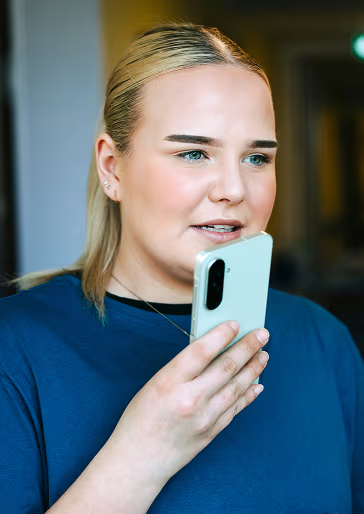
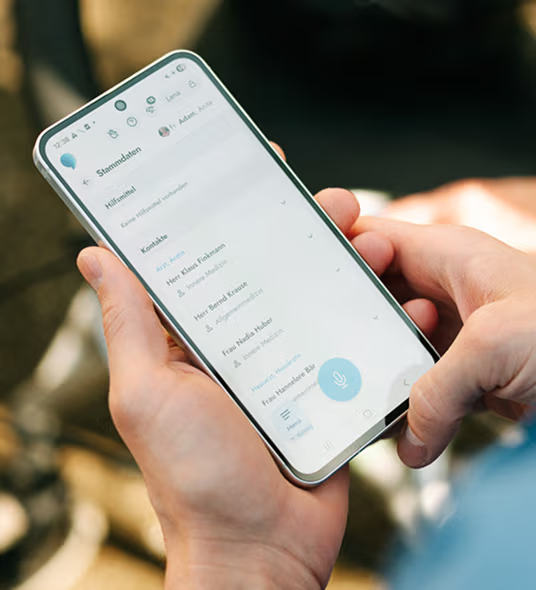
With voize, nurses can document the assessment results right on the spot through their mobile phone. This frees them from end-of-shift documentation and can increase the documentation quality. Find out more about voize here.
What are the key differences between PDPM and RUG-IV?
RUG-IV was a system based on many repetitive assessments with little possible adjustments between the assessments. PDPM requires less assessments and allows for more adjustments based on the patient's needs.
Payment calculation logic
Under RUG-IV, a patient's base rate was multiplied by a fixed Case Mix Index tied to their assigned RUG group. That rate then stayed constant for the length of the assessment period. This meant payment didn't reflect how a patient's actual care needs might change day to day within that period, since the rate was locked in until the next scheduled reassessment.
Under PDPM, the Variable Per Diem (VPM) adjusts the daily rate throughout the stay based on the patient's evolving needs. This produces a payment model that tracks the patient's real trajectory of care instead of freezing a snapshot from the last assessment.
Role of diagnosis codes (ICD-10)
Under RUG-IV, classification into a payment group depended heavily on therapy minutes and ADL (functional) scores. This created a strong incentive to maximize therapy volume rather than to document the patient's actual clinical picture.
Under PDPM, ICD-10 codes captured during the 5-day assessment directly drive classification and the VPM adjustment. This ties payment more closely to the patient's real diagnosis and care needs rather than to how many therapy minutes a facility chooses to deliver.
Number of nursing functional groups
Under RUG-IV, the nursing component used a larger, more granular set of case-mix groups to classify patients. This added complexity to classification without necessarily improving accuracy.
Under PDPM, the nursing component was consolidated to 25 case-mix groups. This simplifies classification and reduces administrative overhead for nurses while still capturing meaningful differences in patient needs.
Frequency of assessments
Under RUG-IV, facilities were required to complete up to five scheduled assessments per stay (5-day, 14-day, 30-day, 60-day, 90-day), plus additional assessments tied to therapy start, end, or changes. This repeated assessment burden consumed significant time throughout a patient's stay, pulling staff away from direct care.
Under PDPM, only one initial assessment period and one discharge assessment are required. This reduces documentation burden, freeing staff time for patient care.
Readmission policy
Under RUG-IV, there was no formal readmission distinction at all because a patient's flat per-diem rate didn't change over the course of a stay regardless of a brief discharge and return. This wasn't an issue under RUG-IV's flat-rate structure. But PDPM introduced a variable per diem that decreases over time. Without a rule to prevent it, facilities could exploit this system by discharging and quickly readmitting a patient just to reset the schedule and recapture a higher early-stay rate.
Under PDPM, a readmission to the same SNF
- within three calendar days counts as a continuation of the same stay. No new assessment, the per diem clock simply pauses and resumes.
- after more than three days counts as a new stay, requiring a full five-day assessment and restarting the per diem from scratch.
Important: If a patient is admitted to a new SNF, this is always considered a new stay.
This distinction both protects the payment system from being gamed via short, strategic discharges and avoids penalizing facilities administratively for brief, clinically necessary interruptions.
Why is an accurate PDPM documentation so important?
Accurate documentation during the assessment period has to hold up to a high quality standard for five reasons:
- It must reflect the full observation period: The PDPM assessment relies on the “usual performance” across the three day observation period. A single day does not reflect that “usual performance” of the patient. Note that this window starts differently depending on the patient's payer status: for Medicare Part A patients, it begins on the "Start of Most Recent Medicare Stay". For all other patients, it begins on their "Entry Date."
- It must use precise, GG-code-aligned language: Vague or generic notes ("had a bad day") don't provide a traceable basis for a specific code. Nurses need to translate their observations into the specific activity language GG coding requires. For example, instead of noting "ate well," documentation for the eating category should reflect the GG standard directly: "the ability to use suitable utensils to bring food and/or liquid to the mouth and swallow food and/or liquid once the meal is placed before the patient."
- It must stay consistent until discharge: The GG codes and ICD-10 codes established during the initial 5-day assessment must align with documentation recorded throughout the entire stay. Conflicting records later on might impact the reimbursement amount.
- It must be reviewable by an external party: Narrative documentation is part of the permanent legal medical record. It must be so clear that external reviewers can always determine how the “usual performance” was established.
- Case mix index and staffing: GG item scores feed into the case mix adjustments. These affect reimbursement amounts and staffing decisions within the facility. Metrics like “Total Nursing Hours Per Resident”, “Registered Nurses Hours Per Resident”, and “Total Nursing Hours Per Resident on Weekend Days” can all be impacted.
voize is the AI companion for nurses that turns spoken notes into structured documentation synced in real time to the existing EHR system. It is trained on clinical terminology as well as nursing workflows and accurately navigates section GG coding and language - crucial for both the nurses and facilities who rely on accurate reimbursement to staff and care for their patients. Find out more about voize here.
PPS discharge requirements within PDPM
The Prospective Payment System Discharge (PPS Discharge) is required under PDPM for any reason when
- A patient is discharged from an SNF
- Or the 120 days of funded stay are reached.
The only exception is when a patient dies in the facility.
The PPS discharge must be completed within 14 days of the “End of Stay” date. It cannot include any assessments that occur after that date, even if missing assessments are only discovered once the PPS Discharge is being completed.
Once again, the GG codes are used to assess the patient at the close of their Medicare Part A stay. They must align with the documentation recorded throughout the stay and the ICD-10 codes originally documented during the initial 5-day assessment period. Conflicting records or gaps in the patient’s care record have a direct impact on reimbursement in this way.
Facilities across the US have developed their own internal systems to try and mitigate any discrepancies that may arise between the initial assessment and the PPS Discharge. But the challenge for nurses to balance performing care and documenting the care performed has presented no easy, catch-all solutions.
This is where voize comes in. Its care planning agent is designed to prompt nurses when documentation is missing or incomplete, allowing it to be addressed immediately - again crucial for both the nurses and facilities who rely on accurate reimbursement to staff and care for their patients. Find out more about voize here.




Book a demo
Better documentation. Better care.