Case Mix Index in nursing homes: what your CMI score is actually telling you
A below-average case mix index doesn't always mean your residents have lower care needs. More often, it means the care your team is delivering isn't being fully captured in the record. Under PDPM, documentation and reimbursement are directly linked. What's documented accurately gets classified accurately and classification determines what a facility receives per resident per day. This article explains how CMI works, why documentation gaps are the most common driver of under-performance, and what care teams can do to close that gap without adding to an already full shift.

What is the Case Mix Index in nursing homes?
Case Mix Index (CMI) is a numeric measure of the clinical complexity and resource intensity of a facility's resident population. A higher CMI reflects residents with greater care needs and under case-mix-adjusted payment models, it translates directly into higher reimbursement.
The mechanism: when an MDS assessment accurately captures a resident's full clinical picture, the resulting classification group reflects actual acuity. When documentation is incomplete, the classification falls below what the clinical reality supports and reimbursement follows.
The national average nursing CMI for skilled nursing facilities sits roughly between 1.14 and 1.37. A facility that consistently falls below that range should treat it as a signal — not necessarily of lower-acuity residents, but of documentation practices that may not be capturing everything that's happening in care.
How the CMI is calculated under PDPM
Since October 2019, Medicare skilled nursing reimbursement has operated under the Patient Driven Payment Model (PDPM), which replaced the RUG-IV system. Under PDPM, reimbursement is divided into six components — five of which are case-mix adjusted:
- Nursing (the primary driver of CMI)
- Physical Therapy (PT)
- Occupational Therapy (OT)
- Speech-Language Pathology (SLP)
- Non-Therapy Ancillaries (NTA)
Each component is classified using Minimum Data Set (MDS) assessment data — clinical diagnoses, functional status, care needs, and services provided. Residents are placed into classification groups within each component, and those groups set the reimbursement rate.
The nursing component CMI most directly reflects both resident acuity and documentation completeness. It's also the component that now influences Five-Star staffing ratings.
For Medicaid, states are progressively transitioning to PDPM-based CMI models. As of 2026, the majority of states have adopted or are moving toward PDPM CMI for Medicaid reimbursement.
Why a below-average CMI usually points to a documentation gap
A facility's CMI can be genuinely lower because its residents have lower acuity. But this is less common than it appears. More often, residents' clinical complexity simply isn't being fully reflected in the MDS.
Here's how that gap forms in practice:
- Conditions go unrecorded in the clinical record. If a resident has COPD and sleeps with their head elevated because lying flat causes breathlessness — but neither the positioning nor the symptom is documented — the MDS can't capture it, the classification falls, and reimbursement drops. The care is still happening. The revenue isn't.
- Clinical changes miss the lookback window. MDS assessments are time-bound. If something changes between quarterly assessments and it isn't documented in the medical record during the assessment reference period, it can't be captured in the MDS — even if the MDS coordinator is aware of it.
- Documentation lags behind clinical reality. When care is documented at the end of a shift from memory, subtle but meaningful changes — increased assistance with transfers, new pain complaints, changes in eating behavior — get compressed or missed. Those details matter for classification.
The financial consequence is direct. What isn't documented can't be classified. What isn't classified isn't reimbursed.
The revenue that's already there
The gap between a facility's current CMI and what accurate documentation would support translates into per-diem differences that compound across a full census and a full year.
Under PDPM, even modest improvements in nursing component classification — driven by more complete MDS documentation — can represent meaningful daily rate increases across the resident population. Clinical Documentation Improvement programs focused on documentation specificity have produced CMI increases of over 40% in some facilities.
For administrators and operators, this isn't an abstract quality metric. It's revenue the team is already earning that isn't being captured.
CMI, five-star ratings, and survey exposure
CMI doesn't only affect direct reimbursement. It also shapes a facility's Five-Star rating, specifically the staffing domain, which CMS surveys now adjust for nursing CMI.
Facilities with lower CMI scores relative to their actual staffing levels may see their staffing star rating recalibrated downward, even without any change in headcount. Lower star ratings increase regulatory scrutiny and affect referral volume.
The pattern compounds: under-documentation lowers CMI, lower CMI depresses the staffing rating, and a lower rating brings more survey attention. All of it traces back to documentation completeness.
How to improve CMI without adding burden to the team
The goal isn't more documentation — it's more accurate documentation, captured at the right moment.
- Build a CMI review process for long-term residents: Most MDS focus falls on short-term skilled residents. Long-term residents are where CMI gaps are most common and most costly. A regular CMI review — separate from the standard PPS meeting, focused on the full census — surfaces residents whose acuity may not be reflected in current coding.
- Document clinical changes at the point of care: When nurses document observations immediately — in the moment, not hours later — more clinical detail is captured. That specificity is what MDS classification depends on.
- Connect nurses and MDS coordinators around what to document: Direct care staff are the first to notice changes in a resident's condition. If those observations don't make it into the clinical record with sufficient detail, MDS coordinators can't code accurately regardless of how strong their process is.
- Use the lookback window intentionally: MDS assessments have a specific reference period. Clinical changes that occur but aren't documented within that window can't be captured, even if they're known. A consistent habit of timely documentation closes this gap.
- Audit CMI data quarterly: iQIES and your EHR should allow comparison of current CMI against prior quarters and against state or national benchmarks. Persistent gaps between clinical acuity and CMI scores are a concrete starting point for targeted improvement.
Frequently asked questions regarding the Case Mix Index
What is a good case mix index for a nursing home?
The national average nursing CMI under PDPM ranges roughly from 1.14 to 1.37. A facility consistently below that range, without a clear clinical explanation, likely has documentation gaps that are suppressing classification and reimbursement.
How does PDPM affect nursing home CMI?
Under PDPM, five of six reimbursement components are case-mix adjusted using MDS data. The nursing component is most significant: it drives per-diem reimbursement rates and influences the Five-Star staffing rating. Accurate MDS coding, grounded in thorough clinical documentation, is the primary lever.
Can documentation improvements actually increase CMI?
Yes. The most common driver of below-average CMI is incomplete documentation, not lower resident acuity. When clinical observations, diagnoses, functional needs, and care interventions are captured fully and in real time, MDS assessments reflect resident complexity more accurately, supporting higher classification and higher reimbursement.
Why do nursing homes under-report on MDS assessments?
This under-reporting is almost always a workflow problem, not an intent problem. When care is documented retrospectively and from memory, the clinical specificity MDS classification needs gets compressed, conflicting or lost. Capturing documentation closer to the moment of care is the most direct fix.
How often should nursing homes review their CMI?
At minimum quarterly, aligned with MDS cycles. Facilities with known documentation gaps or recent staffing transitions may benefit from monthly reviews to catch issues before they compound across a full quarter.
How voize helps improve CMI
The gap between a facility's actual CMI and what accurate documentation would support almost always comes back to the same moment: care was delivered, but details of it are not reflected in the record.
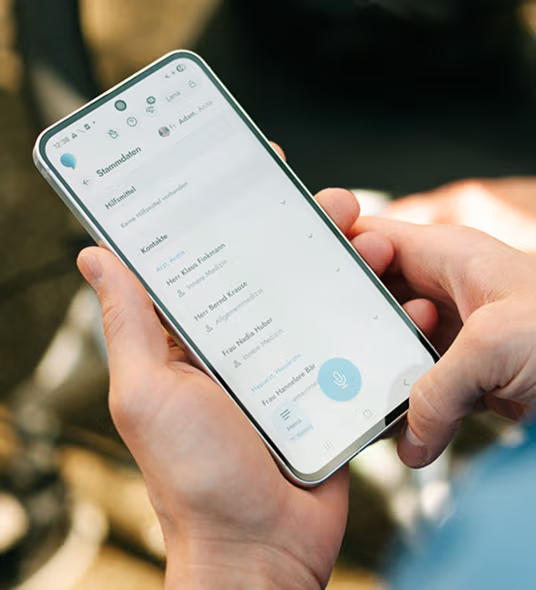
voize addresses this at the source by moving documentation from the end-of-shift to in the moment care is delivered.
- Clinical detail captured while it's still clear: When a nurse notices a resident sleeping elevated due to breathlessness, or sees increased difficulty with a transfer, that observation matters for MDS classification. Spoken into voize right after the interaction, it lands in the clinical record with the specificity MDS coordinators need. Documented hours later from memory, that same detail often gets compressed or lost.
- MDS coordinators working from a fuller picture: voize doesn't replace clinical judgment, instead it gives the team stronger material to work from. When the clinical record accurately reflects the full lookback period, classification decisions are grounded in what actually happened, not in what staff could piece together after the fact. That's what brings CMI closer to what clinical reality supports.
- A workflow that fits how care teams actually work: The best documentation system is the one people use consistently. voize was built for shift work — it works at the bedside, in the hallway, in real conditions. Staff speak naturally; voize structures the documentation. There's no new screens to navigate, no extra steps added to an already full shift. When documentation fits into the rhythm of care, rather than interrupting it, the care delivered is strengthened.
- AI agents that stay ahead of gaps: Beyond capturing what's spoken, voize AI agents actively support care teams — surfacing upcoming assessment windows, flagging residents whose documentation may be lagging and helping teams stay ahead of the gaps that suppress CMI. Documentation that works for the facility, not just for compliance.
voize is used by more than 2,000 care facilities and 180,000 care workers. In a study published in JMIR, facilities using voize reduced documentation time by 27 % — freeing up the clinical attention that accurate, complete records depend on. Find out more about voize here.



Book a demo
Better documentation. Better care.