How to stay CMS survey-ready year-round: A practical guide for long-term care teams
A CMS survey doesn't announce itself with much warning. For most skilled nursing facilities, the recertification window opens somewhere between 9 and 15 months after the last visit and complaint surveys can arrive any day in between. This guide covers what CMS surveys assess, where facilities most commonly face citations, and how care teams can build the kind of consistent documentation practice that holds up under high pressure shifts.

What is a CMS nursing home survey?
A CMS nursing home survey is a federal regulatory inspection that evaluates whether a facility meets the Requirements of Participation (RoP) under 42 CFR Part 483. State Survey Agency surveyors assess resident safety, care quality, staffing, and documentation practices. When they identify gaps, they cite deficiencies using a standardized system of F-tags.
Facilities must be surveyed at least once every 15 months, with a national average interval closer to 12. Complaint surveys operate outside that cycle entirely — they happen when a concern is raised, on any day, with little notice.
Since 2025, CMS has updated its Long-Term Care Survey Process (LTCSP) guidelines significantly: revised guidance on MDS assessment accuracy, documentation of psychotropic medications, care planning, and how surveyors investigate documentation gaps. Updated guidelines went into full effect April 2025.
What's at stake when deficiencies are cited
Deficiencies have real consequences: financial, reputational, and operational. Depending on severity and scope, citations can lead to reduced ratings, civil monetary penalties, increased survey frequency, or in the most serious cases, loss of Medicare and Medicaid certification.
Under the CMS risk-based survey (RBS) pilot, facilities with strong compliance histories qualify for a more focused, less time-intensive survey process. The pattern works in reverse too: repeated deficiencies place a facility in higher scrutiny. Survey readiness and operational quality reinforce each other.
Where facilities most commonly fall short
The same F-tags appear year after year in national deficiency data. These aren't obscure regulatory edge cases, but rather everyday situations that care teams encounter on every shift.
- F689 – Free of Accident Hazards / Adequate Supervision: One of the most consistently cited tags. Deficiencies arise when documentation of fall risk assessments, supervision plans, or care interventions is incomplete or out-of-date. If a resident falls and the record doesn't reflect a current risk assessment and care plan update, surveyors will look more closely into the facility.
- F656 – Comprehensive Care Plans: Among the top-cited F-tags nationally. The most common issue isn't the absence of care plans — it's care plans that don't reflect where a resident is today. Conditions change. Documentation that happens at the point of care makes it far easier to keep care plans current.
- F641 – Accuracy of MDS Assessments: As of 2025, CMS updated surveyor guidance on F641 to explicitly include review of MDS coding accuracy. When the MDS doesn't match the clinical record, facilities face both compliance risk and reimbursement consequences under PDPM.
- F880 – Infection Prevention and Control: A perennial citation. Surveyors routinely scrutinize documentation of infection surveillance, staff training, and response protocols.
- F684 – Quality of Care: A broad tag, cited when care delivery concerns are visible but the documentation doesn't show that the team identified, assessed, and responded to a resident's changing needs.
The common thread: facilities aren’t failing to provide care. The issue is capturing care accurately, in a way surveyors can feasibly verify.
Find out more in this article: Common CMS Deficiencies in US Nursing Homes
Why documentation is the foundation of survey readiness
Surveyors evaluate what's in the record. When care happens but isn't documented, or is documented but after-the-fact, incompletely, or inconsistently, it creates vulnerability even when the actual care was appropriate.
The clinical reality in most facilities is that care teams are delivering continuous, attentive care throughout every shift. But documentation tends to happen in compressed windows, often at the end of the shift, when fatigue is high and details harder to recall. This is where the gaps appear.
When documentation happens at the point of care instead (a nurse speaking a note as they leave a resident's room, immediately structured and entered in the EHR) the record reflects what actually happened. No reconstruction. No end-of-shift backlog. No gaps for surveyors to question.
Building survey readiness into daily operations
Survey readiness is less about preparation and more about practice. Here's what it looks like when it's working well:
- Regular internal audits: Monthly documentation audits, focused on the high-risk F-tags above, surface gaps while there's still time to close them. iQIES reports are a practical starting point for identifying documentation patterns across the resident census.
- Mock surveys: A structured mock survey helps staff know what to expect, reduces anxiety, and surfaces compliance issues before they become citations. Teams who've been through a mock survey respond better during the real thing — they know where records are and how to answer surveyor questions clearly.
- Care plans that reflect present day status: Care plans need to reflect a resident's current clinical picture. Build a process where updates happen when conditions change, not only during scheduled review cycles. When care teams document at the point of care, care plan currency follows naturally.
- Year-round staff training, not just pre-survey: Survey knowledge shouldn't live only with the DON. Every team member, including CNAs, should understand how care is documented, where records are kept, and what surveyors are assessing. CMS's updated LTCSP guidance and QSO-25-19 memo are useful references.
- Monitoring your public data: CMS Care Compare publishes star ratings, inspection history, staffing data, and quality measures. Review this quarterly; it's the same data surveyors review before arriving, and the same data families and referral sources use when evaluating your facility.
The 15-month window is not a planning buffer
A practical reality worth naming: the 15-month maximum survey interval is a regulatory ceiling, not a realistic planning timeline. The national average is closer to 12 months and facilities with lower star ratings and more deficiencies tend to be surveyed more frequently, sometimes every 9–10 months.
Complaint surveys fall entirely outside that cycle. They arrive when a concern is raised, with little or no advance notice.
Planning survey readiness around the maximum interval leaves almost no room for the unexpected. Year-round operational discipline is the only reliable approach.
Frequently asked questions about CMS surveys
How often does CMS survey nursing homes?
CMS requires recertification surveys at least once every 15 months, with a national average of around 12 months. Facilities with deficiencies or complaints are often surveyed more frequently. Complaint surveys can happen at any time and without advance notice.
What are F-tags in a CMS nursing home survey?
F-tags are the federal coding system surveyors use to identify and cite regulatory violations. Each requirement under 42 CFR Part 483 has a corresponding F-tag. Among the most commonly cited: F689 (accident hazards and supervision), F656 (comprehensive care plans), and F641 (MDS accuracy).
What is the most common reason nursing homes receive deficiencies?
Documentation gaps. Surveyors evaluate what's in the record: when care was provided but not documented, or documented inconsistently. Citation risk exists even when the care itself was appropriate.
How does documentation quality affect survey outcomes?
Directly. Surveyors review care plans, MDS assessments, care notes, and incident reports to verify that care was assessed, planned, and delivered correctly. Incomplete or retrospective documentation raises questions, and questions lead to deeper investigations.
Can AI documentation tools help with survey readiness?
Yes! When AI supports real-time documentation at the point of care, records more accurately reflect what happened during a shift. This reduces end-of-shift backlogs, improves MDS coding accuracy, and keeps care plans current, all which address the documentation gaps most frequently driving deficiency citations.
How voize helps your team stay survey-ready
Survey readiness comes down to one thing: records that consistently reflect the care your team actually delivers. That's hard to achieve when documentation happens at the end of a shift, far removed from the point of care, and when gaps in the record only become visible while a surveyor is already in the building.
voize addresses both sides of that problem: documentation that happens at the moment of care and a quality agent that actively monitors for gaps before they become citations.
Documentation that happens at the point of care
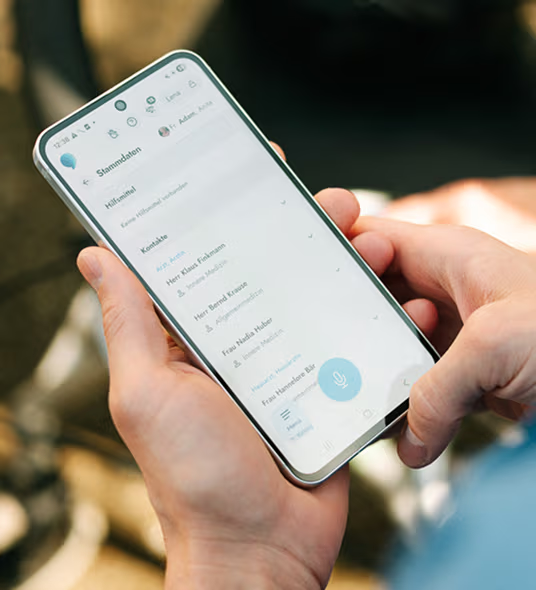
Care staff speak their observations, interventions, and residents’ responses directly into voize — in the hallway, at the bedside, or right after a clinical interaction. voize structures the speech and maps it to the correct field in the EHR. By the time the shift ends, the record already reflects what happened during it. No reconstruction. No end-of-shift backlog. Synchronized across all team devices.
Care plans that keep up
F656 gets cited when care plans don't reflect a resident's current picture. When observations are captured at the point of care, changes in condition surface in the record faster and care plan teams work with more current, more complete information.
A weekly quality check that flags gaps before they compound
Beyond capturing documentation in real time, voize AI agents run a structured quality check across the resident census. The agent identifies discrepancies between care assessments and care plans; the kind of mismatches that emerge when a condition changes but the plan hasn't been updated to reflect it. These are precisely the gaps that drive F656 and F684 citations.
Rather than waiting for an internal audit, a mock survey, or a real inspection to surface these issues, care teams receive a clear view each week of where the record doesn't match the clinical picture (while there's still time to close the gap). QM staff and care leaders can see which residents need attention, act on it, and maintain a facility where documentation reflects care as it actually happens.
This is what survey readiness looks like when it's embedded in daily operations rather than bolted on before inspection week.
A calmer survey week for your team
When records are consistently complete and discrepancies are addressed routinely, survey preparation isn't a scramble. Staff know the documentation reflects their actual practice. They can answer surveyor questions from a place of confidence rather than trying to reconstruct what happened weeks ago. voize doesn't just improve records. It changes how your team experiences the survey process.
voize is used by more than 2,000 care facilities and 180,000 care workers. In a study published in JMIR, facilities using voize reduced documentation time by 27 % — creating space in each shift for the clinical attention that survey-ready care depends on. Find out more about voize here.



Book a demo
Better documentation. Better care.